Japanese PS1 hidden gems can take you far beyond the console's familiar international releases. Here, the term means five distinctive games that may be less familiar to international players. It does not mean they are objectively better, rarer or more valuable than other titles.
This is not a ranking. Think of it as five paths into the Japanese catalog: an anti-RPG, interactive cinema, a cooking simulation with unusual controls, an observation game about rescuing aliens and an action RPG built around a growing community. If you want a broader introduction first, our guide to
Japanese PlayStation 1 games explains the main collector questions across the catalog.
Whichever path catches your attention, the exact version still matters. A later port, localization or archive edition may include features and language options that are not part of the original Japanese PlayStation disc.
What Hidden Gem Means in This Guide
"
Hidden gem" is an editorial discovery label, not a formal industry category. It does not prove that a game is scarce, exclusive, inexpensive, overlooked in every market or suitable for every player.
Each selection follows four practical criteria. The game has a documented original PlayStation release. It represents a distinctive design path. Reliable sources allow us to describe it carefully. It also connects naturally to the wider Negai Japan PS1 cluster or to an existing IMP3 review. Later versions appear only when they help prevent confusion about the original disc.
That last point matters. Discovery articles often blur several different ideas together. A Japanese release is not automatically exclusive to Japan. A modern English localization does not add English to an earlier Japanese disc. A game that feels unfamiliar to one player may already be well known to another.
How these games were selected
Each title has a documented PlayStation release, a distinct reason for inclusion and enough source context to separate the original Japanese version from later releases. This is an editorial selection, not a ranking of rarity, value or objective quality.
Five Different Japanese PS1 Discoveries
The order below is about variety, not competition. For each game, we will look at what makes it distinctive, which release details matter and what to consider about language before choosing a version.
moon: An Anti-RPG That Turns Familiar Rules Around
Love-de-Lic and ASCII released
moon for the Japanese PlayStation in 1997. The current
Onion Games description calls it an anti-RPG because it questions behaviors that role-playing games often treat as normal. Instead of defeating monsters for experience, the player follows the destruction left behind by a conventional hero, releases monster souls and gathers Love.
That reversal makes
moon a natural first stop on this list. The setting feels recognizable, but the game asks you to reconsider familiar RPG habits. Characters follow daily routines, so learning where they go and when they appear becomes part of understanding the world.
The original disc must be separated from later releases. The Japanese PlayStation edition arrived in 1997. Onion Games then revived the game for Nintendo Switch in Japan in 2019 and released it internationally in English in 2020. That later English localization does not add English to the original Japanese disc.
Research the language needs of the exact version you are considering. The modern release can make the game easier to explore internationally, but it does not prove that a Japanese PS1 listing offers the same text options or supporting materials.
Policenauts: Interactive Cinema on the Original PlayStation
Konami describes
Policenauts as an
interactive cinema adventure. Its science-fiction detective story follows private investigator Jonathan Ingram, whose search for a missing person leads him toward the space colony Beyond. For collectors reading this guide, the key release is the Japanese PlayStation version from January 1996.
This is a very different path from
moon. The appeal lies in investigation, dialogue and cinematic presentation rather than a reversal of RPG systems. It shows how the PlayStation catalog can serve players who enjoy story structure as much as mechanical action.
The PlayStation edition was not the beginning of
Policenauts. Release records identify earlier versions on other Japanese hardware, so the work should not be called a PlayStation original. The PS1 release also appeared in multiple Japanese physical editions, giving collectors another reason to check the edition and product information shown in a listing.
Language is central to this experience. Information about an unofficial translation or another platform does not change the contents of an original Japanese copy. This guide does not cover patching or emulation, so assess the language demands of the exact PS1 release you are considering.
Ore no Ryouri: A Cooking Game Built Around the Sticks
Ore no Ryouri is a Japanese PlayStation cooking simulation released in 1999. It turns restaurant work into direct controller actions. A
PlayStation Blog account recalls an imported demo as a twin-stick cooking game where the player prepared food and poured drinks for customers under time pressure.
The control idea is what brings the game into this selection. Cooking is familiar, but the physical inputs and restaurant pace create a sharp mechanical contrast with the two story-focused games above. An everyday activity becomes the basis for an unusual PlayStation design.
The imported demo mentioned in that article should not be confused with an English retail edition. Release data identifies the original Japanese PlayStation game from 1999, followed by Japanese budget editions and a later PSOne Classics version. Each belongs to a different product context.
Physical actions do not automatically make the game language-independent. Menus, instructions, customer requests and timing cues may all shape the experience. Check the Japanese disc and its materials directly instead of transferring assumptions from a demo, guide or later digital release.
UFO: A Day in the Life: Watch Closely Before You Act
ASCII released
UFO: A Day in the Life for the Japanese PlayStation in 1999. After a spacecraft accident, aliens go missing inside an apartment. The player watches its residents, learns their routines and photographs the aliens at the right moments so they can be rescued.
This is a discovery path built on patience and attention. Progress comes from noticing what changes and when, not from treating every problem as combat. The small apartment gradually becomes a network of overlapping routines, with its residents and unusual visitors forming part of the puzzle.
Our
IMP3 review of UFO: A Day in the Life explores that experience in more depth. Any observation about how quickly its patterns become understandable remains Leandro's experience, not a universal difficulty or language rating.
The original PS1 disc must also remain separate from the current
Console Archives release. The modern version uses the Japanese ROM for the game itself, while its options menu and manual support several languages. Those modern menu and documentation features do not describe the 1999 disc. Anyone considering the original release still needs to evaluate that version on its own terms.
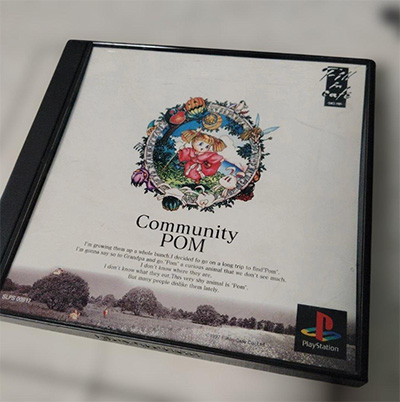
Community POM: Action RPG Ideas With a Growing Village
Fill-In-Cafe released
Community POM for the Japanese PlayStation in 1997. It is an action RPG where Lulu befriends creatures called Poms, brings them into battle and develops a village for them. Combat, companion management and community growth work together, giving the game a different rhythm from a straightforward dungeon adventure.
That mixture is why it belongs here. Poms help in combat and exploration, while the village develops useful buildings as the player cares for its residents. Activity in the field affects life back at the settlement, linking action RPG systems with a community-building layer.
Our
IMP3 review of Community POM describes these systems through Leandro's play experience and points out several unusual interface decisions. Those impressions add context, but they are not universal judgments about quality or difficulty.
Language requires the same care. The review notes that simple-looking scripts do not automatically make stylized dialogue easy to follow. Hiragana, katakana and limited kanji may still be challenging when characters speak in playful or unconventional ways. This is an attributed observation, not a fixed learner level. Research the original 1997 Japanese release and decide whether its text, instructions and interface match your needs.
Five Paths, Not a Ranking
These games are more useful as five discovery paths than as positions on a score list:
- moon reconsiders familiar RPG rules;
- Policenauts centers story and interactive cinema;
- Ore no Ryouri turns cooking into an unusual control challenge;
- UFO: A Day in the Life builds puzzles around observation and timing;
- Community POM combines action RPG ideas with companions and a growing village.
Your starting point depends on what you want to explore. A player drawn to narrative may begin with
Policenauts. Someone curious about unusual systems may look first at
moon or
Ore no Ryouri. A reader who prefers slow observation or community-building mechanics may gravitate toward
UFO or
Community POM.
None of those preferences creates a universal order. The list simply shows how many directions one console catalog can take, then helps you identify the exact release behind the idea that caught your attention.
Check the Exact Release Before You Choose a Copy
Discovery is only the beginning. Once a title interests you, separate the game's general concept from what the listing confirms about the physical copy being offered.
Separate the Original Disc From Later Versions
Check the platform, publisher, release label and any visible product code. A port, archive release, budget edition, remake or later localization may include different menus, language options or supporting materials. Those features do not automatically apply to an earlier Japanese disc.
This is especially important for games such as
moon and
UFO, whose modern versions make them easier to encounter internationally. A later release may be useful, but it remains a different version with its own features and documentation.
Decide What Matters for Your Collection or Play Plans
Start with what you want from the game. You might be looking for the original Japanese disc, a particular package, a later version you can read more comfortably or simply a practical way to experience the title. These are different goals.
Compare the region, language, edition and included materials with that goal. A copy can be historically interesting without fitting your hardware or language needs. A later edition can be convenient without replacing the appeal of the original physical release.
Review the Exact Listing
Use the listing being sold, not a generic game page. Compare the visible title, edition, photos, description and included materials. When the evidence does not confirm a detail, keep it unresolved instead of choosing the most favorable interpretation.
Our guide to
how to buy PlayStation 1 games from Japan explains the full listing-review process, including release, compatibility, language, condition and the main cost stages to consider.
Frequently Asked Questions About Japanese PS1 Hidden Gems
What Does Hidden Gem Mean in This Guide?
It is an editorial label for a distinctive game that may be less familiar to an international reader than the console's most obvious classics. It does not mean that the game is objectively better, rare, expensive, exclusive or suitable for every player. The five titles were selected because they represent different design paths and have enough release context to separate the original disc from later versions.
Are All Japanese PS1 Hidden Gems Exclusive to Japan?
No. "Hidden gem," "Japanese release" and "Japan-exclusive" mean different things. A game may have appeared on earlier hardware, received another regional edition or gained a later port or localization.
Policenauts, for example, existed on other hardware before the PlayStation version. Check the exact platform, edition and region instead of inferring exclusivity from a Japanese PS1 listing.
Do You Need Japanese to Play These Games?
It depends on the game and version. Narrative, menus, instructions, timing cues and stylized dialogue create different demands. A modern English localization of
moon does not add English to the original PS1 disc. Likewise, the multilingual options menu and manual in the modern
UFO release do not describe the 1999 physical edition. Research the original release instead of relying on language information from another version.
How Can You Check Which PS1 Version You Found?
Save the full listing title and URL. Then compare the platform, publisher, release label, visible product code, photos and included materials. Separate the original game from budget reissues, archive versions, ports and later localizations. If the listing does not confirm a detail, leave it unresolved and ask for clarification when possible. The Negai Japan buying guide provides a fuller checklist for reviewing the exact listing.
Which Discovery Path Would You Explore First?
These five Japanese PS1 hidden gems show how many ways one catalog can surprise you. One game questions familiar RPG behavior. Another presents a science-fiction investigation as interactive cinema. The others place cooking, apartment routines and village development at the center of play.
This is an invitation to explore, not a definitive ranking. The IMP3 reviews of
UFO and
Community POM offer a closer look at two of the games, while the source links help distinguish original discs from later versions.
Whichever path interests you, identify the exact release before choosing a physical copy. Confirm what belongs to that version, decide whether its language and format suit your plans, and keep unsupported listing details open until you find better information.
How Negai Japan can help with a Japanese PS1 listing
Found a Japanese PS1 game you want to investigate?
Send us the product link. We can review the visible title, edition and listing details before your request moves forward. This review does not confirm authenticity, functionality, availability or perfect condition.
 USD
USD BRL
BRL AUD
AUD CAD
CAD EUR
EUR GBP
GBP MXN
MXN




 Kaeru no Ehon: Adventure for the Lost Memories
A look at Kaeru no Ehon: Adventure For The Lost Memories, a 1999 PS1 RPG exclusive to Japan where you build your stats through work, training, and rest instead of grinding battles, all against the clock of a one-year curse.
Kaeru no Ehon: Adventure for the Lost Memories
A look at Kaeru no Ehon: Adventure For The Lost Memories, a 1999 PS1 RPG exclusive to Japan where you build your stats through work, training, and rest instead of grinding battles, all against the clock of a one-year curse.
 How to Buy PlayStation 1 Games from Japan
Learn how to check a Japanese PS1 listing, confirm compatibility and condition, understand the main cost stages and send a product link for review.
How to Buy PlayStation 1 Games from Japan
Learn how to check a Japanese PS1 listing, confirm compatibility and condition, understand the main cost stages and send a product link for review.
 How to Check the Condition of Japanese PS1 Games Before Buying
A practical guide to reviewing photos, seller notes, disc condition, cases, inserts and included materials in a used Japanese PS1 listing before buying.
How to Check the Condition of Japanese PS1 Games Before Buying
A practical guide to reviewing photos, seller notes, disc condition, cases, inserts and included materials in a used Japanese PS1 listing before buying.

 Facebook
 Youtube
 Instagram