Released for the PlayStation 1 exclusively in Japan on October 30th, 1997, Community Pom is a cute and light-hearted action RPG that deserves more recognition than it got, trapped in a Japan-only release. The gameplay also mixes in some city-building elements that, while not very deep, provide a fun distraction between dungeons.
A visual and musical delight
You play as Lulu, a sassy young girl with magic powers and the ability to befriend Poms, small rabbit-like creatures that inhabit the world. After seeing a sheep farmer wrongly accuse the Poms of eating his sheep, Lulu embarks on an adventure to gather all the Poms and protect them.
The first thing that strikes you when playing this game is the cute, charming visual style and the beautiful sprite animation. Clearly a lot of effort went into making this game a visual delight, and it paid off, since it still holds up very well today. The upbeat music is also a highlight, matching the whimsical feeling of the game perfectly.
Gameplay
Lulu's main attack is with her staff. The range is short, but you can build a good combat flow with a mix of dashes, jumps, and charged attacks, including a way to deflect enemy attacks. Being a mage, Lulu can also cast spells, like fireballs, once she finds a book of that element. Instead of an MP system, she can cast a limited number of spells after charging her magic for a few seconds.
Another big part of the battle system is using your befriended Poms to fight alongside you. With a party of up to three Poms, they attack freely once you press R1, and some unleash powerful attacks if you hit them with your staff.
Are you interested in Community POM? We're sure you'll like these products!
Poms are very powerful, but there's a big tradeoff. They build up bad karma every time they kill enemies, and if it gets too high, they turn into evil Mooms, wrecking your village before leaving you for good. To lower their karma, you need to bring them back to the village and feed them. It doesn't rise that fast, but the risk of losing your Poms is always hanging over your head, which keeps you from abusing them, especially on longer outings.
Poms also have special skills for traversing the world, like acting as bridges with their tongues or letting you float over water. This makes it worth revisiting earlier areas once you get a new Pom, since you can find rare items, and even more Poms and sheep.
Overall, the battles aren't too difficult, but some bosses can be a real challenge, especially since your Poms won't attack on their own during boss fights, though they can still pull off special attacks if you hit them with your staff. Poison attacks are particularly annoying, draining your HP until you use a potion. Still, nothing that can't be handled with some pattern recognition, quick reflexes, a feel for your arsenal of attacks, and a few healing potions, which you can only carry in limited quantities.
You can also call forth powerful summons that wipe out an entire screen of enemies, though they seem to have limited effectiveness against bosses. These come from consumable items, so they can't be overused either.
A haven for Poms
A big part of the game is taking care of your own village. After the first dungeon, you get an open field to turn into a haven for rescued Poms. Defeated enemies may drop meat, and depending on which type you feed a Pom, it will take on a different role, like building, tending the vegetable field, or raising sheep. Houses improve your Poms' stats, vegetables can be used as food instead of meat, and sheep can be sold for money.
Your village also grows functional buildings, like a clinic for resting and saving your progress, a store where you can exchange trading cards you find around the world for special items, and even a library hiding a secret dungeon.
You can't choose where a building goes, and the Poms decide what to build next based on a set order or condition, but it's still satisfying to watch your village grow into a bustling town.
Sometimes, when you return to your village, you'll find monsters attacking it. You'll want to deal with them before they cause too much damage, though any building that gets destroyed can be rebuilt.
Experimental ideas, weird decisions
One thing I love about retro games is how they experimented with ideas that didn't yet have a tried-and-true format. That's part of what gives them their unique character, but the downside is that a lot of decisions feel weird and poorly explained, especially through the eyes of someone used to the conventions the gaming industry settled into over the following decades.
For example, it took me a long time to figure out how to add Poms to my party. I talked to them, tried interacting with my tent at the village, dug through menus, and found no option for it. I figured it was something that would unlock later in the game. It was only by luck that, while standing in front of the tent, I pressed square instead of circle, which is the button normally used to interact with objects, and the party-management window finally popped up. Pressing circle in front of the tent does nothing, so there was no real reason for this to be tied to square, a button otherwise used only for attacking.
Let us help you buy Japanese treasures
Let us help you buy Japanese treasures
Ready to access Japan's incredible online stores? Our expert team handles everything from ordering to shipping, so you can focus on finding those perfect items.
Or take the ranch: once I finished building it, I couldn't figure out how to actually put the sheep I'd collected there. Eventually I realized you have to equip a sheep like a consumable item and use it on each open space in the ranch.
This is one of those games where spending time with the manual, or checking guides online beforehand, can save you a lot of frustration, though that's complicated by the fact that it's such a niche, Japan-only title, so the number of guides out there, and their quality, isn't great.
For Japanese learners
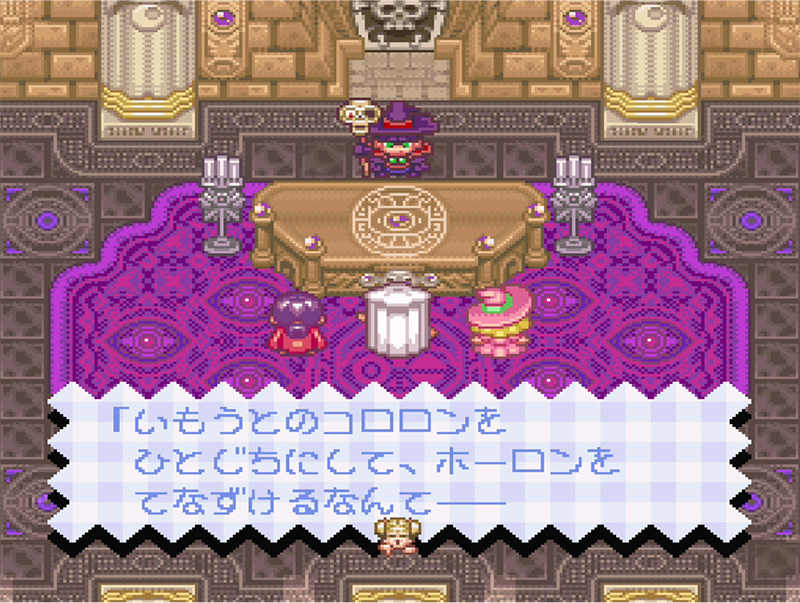
The game only uses easy kanji, and most of the text is in hiragana and katakana. That should make it a good pick for beginners, right? Wrong!
Being a whimsical game, the characters speak in very stylized ways, which is a tool the Japanese language uses to emphasize personality. It works great for Japanese players already familiar with the language, but for us foreigners, it makes things much harder to follow.
There's also a lot of katakana sprinkled into random words, and the lack of kanji makes it harder to tell where words start and end, or to untangle homophones. So even though the game itself has the whimsy of a fairy tale, I'd say it's better suited to upper-intermediate learners.
Conclusion
Even with my love for retro games, especially PlayStation 1 titles, I'd never heard of this one until I stumbled across it in a used game store here in Tokyo. And after seeing the art style, I just had to buy it.
I don't usually reach for the phrase "hidden gem," but I can't think of a better way to describe how I feel about Community Pom. With amazing art direction, good pacing throughout the adventure, a whimsy that appeals to all ages, and fun gameplay, I had a genuinely great time with it.
The plot isn't as deep as the so-called legendary RPGs, and the playtime could be longer, but what's there really won me over, hitting on the things that draw me to retro games most: that touch of experimental design, and the sense that it was made by a team that truly loved what they were doing. I'm sure it would have reached a much wider audience with proper marketing and a western release.
Liked this post?
Follow us on the social media of your choice to be the first to know about our latest updates!
 BRL
BRL AUD
AUD CAD
CAD EUR
EUR GBP
GBP MXN
MXN


 Community POM
 こみゅにてぃ ぽむ
 PlayStation 1






 Magic Knight Rayearth 2nd: The Missing Colors
The Magic Knights return to the Game Boy, and this time it’s a real RPG! My impressions of Magic Knight Rayearth 2nd: The Missing Colors, a Japan-only dungeon crawler with party battles, tricky puzzles and lots of random encounters.
Magic Knight Rayearth 2nd: The Missing Colors
The Magic Knights return to the Game Boy, and this time it’s a real RPG! My impressions of Magic Knight Rayearth 2nd: The Missing Colors, a Japan-only dungeon crawler with party battles, tricky puzzles and lots of random encounters.
 Parappa The Rapper
Parappa the Rapper isn't your typical rhythm game, and it isn't always a fair one either. I dig into the charm, the quirks, and the timing issues of this PS1 classic after playing it for a few hours.
Parappa The Rapper
Parappa the Rapper isn't your typical rhythm game, and it isn't always a fair one either. I dig into the charm, the quirks, and the timing issues of this PS1 classic after playing it for a few hours.
 Kaeru no Ehon: Adventure for the Lost Memories
A look at Kaeru no Ehon: Adventure For The Lost Memories, a 1999 PS1 RPG exclusive to Japan where you build your stats through work, training, and rest instead of grinding battles, all against the clock of a one-year curse.
Kaeru no Ehon: Adventure for the Lost Memories
A look at Kaeru no Ehon: Adventure For The Lost Memories, a 1999 PS1 RPG exclusive to Japan where you build your stats through work, training, and rest instead of grinding battles, all against the clock of a one-year curse.

 Facebook
 Youtube
 Instagram