Chocobo no Fushigi na Dungeon, a Japan-exclusive title with no Western release, was launched for PlayStation 1 on December 23, 1997.
Being one of the first games in the Mystery Dungeon series, which started with Dragon Quest characters and nowadays even has a sub-series based on Pokémon, it's the first title focused on Chocobo, who is accompanied by a Moogle: the two mascots of Final Fantasy.
How does it work?
In Mystery Dungeon series games, the dungeons are randomized, resetting every time you voluntarily leave or when you die. The challenge is to gain levels and stronger equipment to advance further each run, while also keeping an eye on your stamina, which decreases over time and is recovered by eating nuts, and your HP.
Put that way, it sounds simple, but the game is packed with different options and mechanics. Even for those used to playing RPGs, starting this game without at least taking a quick look at the instruction manual is no easy task. There are so many, in fact, that I'd need an entire video just to explain them.
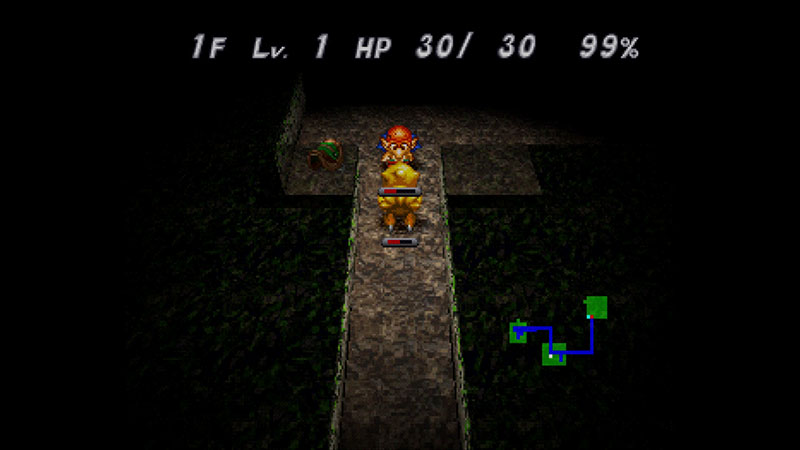
The mechanic that most separates this game from others in the Mystery Dungeon series is that all attacks depend on an ATB bar, coming directly from the Final Fantasy games of that era. By waiting for the bar to fill completely before pressing the attack button, it will be executed at full strength. If the bar isn't full, the attack's strength is proportional to how much of the bar is filled.
Where am I?
Maps are revealed as they're explored, and points of interest like items and enemies are marked on them when found. But exploration must be done carefully, because there are several invisible traps, activated when you step on them, which can have both positive effects, like automatic level up and HP recovery, and negative ones, like spikes that cause damage and poison that prevents automatic HP recovery.
By pressing a button, Chocobo pokes the tile in front of him, revealing traps. However, doing this for each tile before walking takes a lot of time, so at a certain point I just accepted that I could take random damage.
To exit the dungeon, there are only two options: use a teleport card, or die. So it's good to always carry at least one teleport card with you, because without it, the other option would be to die, which makes you lose all items that aren't equipped on the character, and you lose a level.
So many items, so little space
There's a big emphasis on inventory management. The inventory has very limited space, and although it increases a little throughout the game, there's always that feeling that there's never enough space. The message that the inventory is full is a constant presence on your screen.
Are you interested in Chocobo? We're sure you'll like these products!
There's a storage in your house and an extra storage managed by the fat chocobo, both from where you can store and retrieve items between each dungeon run. But even these storages have limited space, and the challenge then is to choose what's worth keeping and what can be discarded.
What makes dealing with inventory harder is that the magic system in this game depends on books: each book is an item and can only be used once to cast a spell. Although books of the same element are stored in the same inventory space, there are 7 different types of magic, so keeping books of all types requires valuable space, which often isn't worth it. However, always have fire-type books, which are used to light cauldrons to fuse equipment and in some other locations.
Equipment and curses
Another important type of item is equipment. There are 3 equipment slots, one for claws, increasing attack; a saddle, increasing defense; and one more for accessories, which can have various effects.
Regarding equipment, there are two important facts. One of them is that as you progress in the game, you unlock the option to fuse equipment to make them stronger, so even weak equipment has some utility.
Another important fact is that some equipment is cursed. Besides lowering your stats when equipped, they also can't be freely unequipped. To do that, you'll have to find a special tile on the ground that unequips all your equipment. If you don't find it, you'll be condemned to use that weak equipment until you can remove it.
How do you know your equipment is cursed? Most items found in the dungeon are marked as "unidentified." Not just equipment, but also potions, nuts, and cards. The effects of these items can only be discovered by using them, which carries the risk of receiving negative effects, or by using identification cards on them.
Is there more?
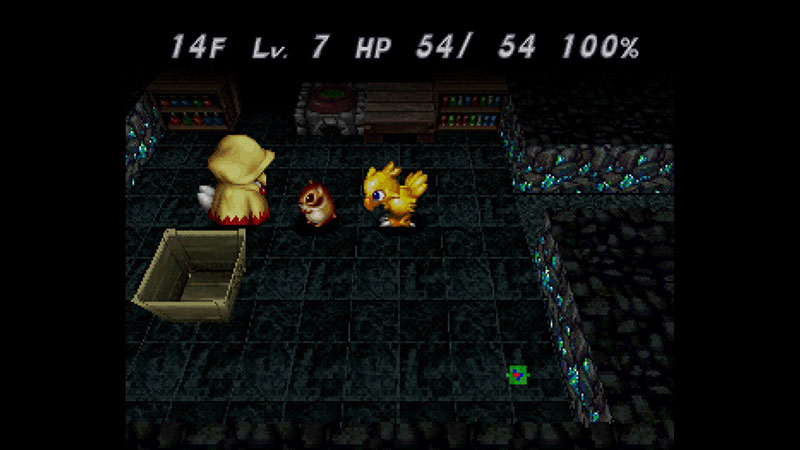
There are several other mechanics and types of items, like nuts with various effects, recycling boxes that transform items into random ones, oil for equipment, a merchant who appears on some floors... But there are too many things for a video about my impressions, so if you want a more detailed video, let me know in the comments and I'll consider making one!
The game loop doesn't change much during the game, so many might find it tiresome after a certain time. But it's undeniable that the game loop of gradually getting stronger and with more powerful items, and going deeper and deeper into the dungeon, has an addictive power. It's no wonder the Mystery Dungeon series continues strong to this day.
Cute characters, not-so-cute scenery
The characters, even the enemies, have a cute and pleasant design, but the scenery didn't receive the same treatment. The small town still manages to have a certain charm, but the dungeon, which takes place in underground caves, has a very basic and monotonous visual design. I would have preferred if this part had received more care.
Let us help you buy Japanese treasures
Let us help you buy Japanese treasures
Ready to access Japan's incredible online stores? Our expert team handles everything from ordering to shipping, so you can focus on finding those perfect items.
The summons, executed through single-use gems, have well-made animations. However, just like in Final Fantasy, sometimes I wish the animations were a bit shorter, especially when using several gems on the stronger bosses.
As expected from Square since its debut on PlayStation 1, there are also CGI scenes, of very good quality considering the time they were made, although they don't have voices.
There is a story, which involves a mysterious stone found at the game's opening, and some mysterious characters. But as far as I've played, the plot seems to be quite simple, so the game attracts more for the gameplay itself than for the storytelling.
What about the Japanese?
Despite the simple plot, the various mechanics and items, including their effects, can be an obstacle for those who don't understand the language. However, for those already studying Japanese, this game can be good practice. There's no furigana, but the texts aren't very complicated, and all dialogue requires the player to press the button to proceed. There are no voice-acted lines, so an online translator and a dictionary are enough to understand the texts and to help with language studies.
It's also worth mentioning that at a certain point, the enemies' strength starts to increase quite a bit, which requires some grinding time. This might turn away some players who prefer a more constant pace of progression.
Conclusion
With all the mechanics present in the game, it took me a while to get the hang of it. But once you learn how it works, and after understanding how to manage the inventory, it's easy to get hooked on the game loop and see how far I can get. Even without being very curious about the story's outcome, maybe one day I'll finish the game, so I can one day play the sequel, which did receive a Western release.
If you have interest in retro games like Chocobo no Fushigi na Dungeon, Negai Japan helps acquire this and many other Japanese treasures!
Liked this post?
Follow us on the social media of your choice to be the first to know about our latest updates!
 BRL
BRL AUD
AUD CAD
CAD EUR
EUR GBP
GBP MXN
MXN


 Chocobo Mystery Dungeon
 チョコボの不思議なダンジョン
 PlayStation 1





 Magic Knight Rayearth 2nd: The Missing Colors
The Magic Knights return to the Game Boy, and this time it’s a real RPG! My impressions of Magic Knight Rayearth 2nd: The Missing Colors, a Japan-only dungeon crawler with party battles, tricky puzzles and lots of random encounters.
Magic Knight Rayearth 2nd: The Missing Colors
The Magic Knights return to the Game Boy, and this time it’s a real RPG! My impressions of Magic Knight Rayearth 2nd: The Missing Colors, a Japan-only dungeon crawler with party battles, tricky puzzles and lots of random encounters.
 Kaeru no Ehon: Adventure for the Lost Memories
A look at Kaeru no Ehon: Adventure For The Lost Memories, a 1999 PS1 RPG exclusive to Japan where you build your stats through work, training, and rest instead of grinding battles, all against the clock of a one-year curse.
Kaeru no Ehon: Adventure for the Lost Memories
A look at Kaeru no Ehon: Adventure For The Lost Memories, a 1999 PS1 RPG exclusive to Japan where you build your stats through work, training, and rest instead of grinding battles, all against the clock of a one-year curse.
 How to Buy PlayStation 1 Games from Japan
Learn how to check a Japanese PS1 listing, confirm compatibility and condition, understand the main cost stages and send a product link for review.
How to Buy PlayStation 1 Games from Japan
Learn how to check a Japanese PS1 listing, confirm compatibility and condition, understand the main cost stages and send a product link for review.

 Facebook
 Youtube
 Instagram